EXECUTIVE SUMMARY
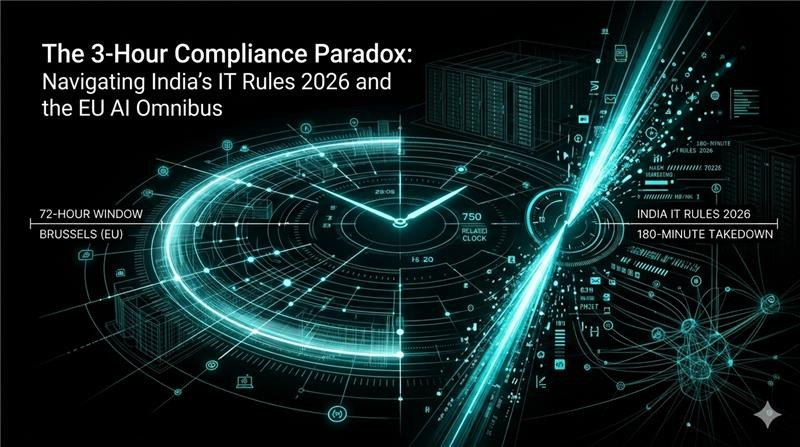
The 180-minute takedown mandate embedded in India's IT (Intermediary Guidelines and Digital Media Ethics Code) Amendment Rules, 2026 specifically targeting Synthetically Generated Information (SGI) now sits in direct operational conflict with the 72-hour breach-reporting framework anchored in the EU AI Act's Article 52 transparency provisions and its subsequent Omnibus amendments.
For Indian software exporters, SaaS platforms, and Global Capability Centres (GCCs) operating under dual-jurisdiction compliance obligations, this is not a theoretical friction point. It is an active liability that will produce the first wave of cross-border AI compliance arbitrations before the end of FY 2026-27.
The core tension: Brussels is engineering a longer, more deliberative compliance chain to ensure AI provenance accountability. New Delhi is engineering a faster, more aggressive takedown architecture to contain synthetic misinformation. A platform simultaneously subject to both regimes cannot satisfy either without a purpose-built compliance infrastructure — one that most mid-sized Indian technology enterprises do not currently possess.
SECTION I: THE REGULATORY COMPARISON MATRIX
| Parameter | EU — AI Act / Omnibus | India — IT Rules 2026 | Status |
|---|---|---|---|
| TRANSPARENCY & DISCLOSURE | |||
| Primary provision | Article 52, EU AI Act — transparency obligations for AI-generated content directed at end users | Rule 3(1)(b)(v) & Rule 4(b) — disclosure and metadata mandates for synthetic/AI-generated content | Aligned |
| Metadata mandate | Provenance watermarking and machine-readable disclosure; Commission delegated acts pending final specification | Mandatory metadata embedding identifying SGI origin; format not yet technically standardised by MeitY | Gap |
| TAKEDOWN & REPORTING WINDOWS | |||
| Takedown / action window | 72-hour incident reporting to national authority (Article 73); content removal timelines subject to DSA Article 17 expedited process | 180-minute (3-hour) hard takedown window for SGI flagged as harmful; no grace period for cross-border verification | Conflict |
| Grace period / appeals | Platform may invoke "voluntary measure" protocol; DSA Article 20 internal complaints mechanism applies | No suspension of takedown obligation pending appeal; grievance redressal post-action only | Conflict |
| RISK CLASSIFICATION | |||
| Risk tiering | Omnibus simplification: four-tier model (Minimal, Limited, High, Unacceptable) with reduced obligations for limited-risk systems | No formal tiering; obligation applies uniformly to all SGI regardless of harm potential | Conflict |
| Exemptions | Research, satire, and national security carve-outs under Article 52(3); GPAI model-level exemptions under Omnibus recitals | No codified satire or research exemption in the 2026 amendment text; MeitY guidance awaited | Gap |
| ENFORCEMENT & LIABILITY | |||
| Penalty structure | Up to €35M or 7% of global annual turnover for high-risk system violations; proportionality principle applies to SMEs | Loss of safe harbour under Section 79, IT Act 2000; potential criminal liability under Section 66 for repeat defaults | Parallel |
| Jurisdictional reach | Extraterritorial — applies to any provider placing AI systems on EU market, regardless of establishment | Applies to intermediaries with users in India; enforced against India-registered entities and their GCC subsidiaries | Overlap Risk |
The matrix above isolates the three structural fault lines that demand immediate C-suite attention: the 72-hour vs. 180-minute window conflict, the absence of a risk-tiering framework under India's rules, and the extraterritorial reach of the EU regime colliding with India's domestic intermediary liability architecture.
SECTION II: THE "MIDNIGHT TAKEDOWN" SCENARIO - AN OPERATIONAL ANALYSIS
Consider a scenario that is no longer hypothetical for Ahmedabad-based data centers and GCCs operating on the SG Road-Bopal corridor or within the GIFT City IFSC perimeter.
A MeitY-designated grievance officer receives a formal complaint at 02:14 AM IST alleging that a piece of synthetically generated audio - hosted on a platform whose origin servers sit in Mumbai but whose contractual data fiduciary is registered in Singapore - constitutes harmful SGI under the IT Rules 2026. The 180-minute clock begins at the timestamp of receipt, not at business hours.
By 03:00 AM IST, the platform's on-call technical team must:
- Verify the provenance metadata of the flagged content against its origination logs
- Determine whether the content simultaneously falls within the EU AI Act's Article 52 disclosure chain, triggering a parallel obligation not to remove without provenance documentation
- Escalate to their Singapore-based data fiduciary for sign-off, who is operating on SGT (+2:30 from IST), making the decision window practically a single individual at 05:30 AM local time
- Execute or refuse the takedown, with both choices carrying liability - one under Indian law, one under EU law
By 05:14 AM IST, the window has closed. The platform is now in default under Rule 4(b) regardless of which jurisdictional obligation they honoured.
This is not an edge case. This is the standard operating condition for any Indian intermediary that has executed a Data Processing Agreement (DPA) with an EU-based controller. The "Midnight Takedown" scenario will produce the first generation of cross-jurisdictional AI compliance defaults - and the indemnity claims that follow will be the founding docket of a new arbitration vertical.
SECTION III: LEGAL & ARBITRATION RISKS - THE PROVENANCE COMPLIANCE CLAUSE
The Emergence of "Provenance Compliance" in SaaS MSAs
Over the past eighteen months, international SaaS Master Service Agreements have begun incorporating a new genus of clause, distinct from standard data protection warranties. The "Provenance Compliance Clause" (PCC) requires the service provider to warrant, at the moment of contract execution and on a continuous basis, that:
- All AI-generated or synthetically augmented content processed through their platform carries machine-readable provenance metadata compliant with the Coalition for Content Provenance and Authenticity (C2PA) technical standard - the de facto standard now referenced in EU Omnibus drafting notes
- The provider maintains a 24/7 regulatory response capability capable of executing jurisdiction-specific takedown or preservation obligations within the contractually specified window
- Any failure to meet the applicable national takedown window including India's 3-hour SGI mandate constitutes a material breach triggering indemnity obligations, not merely a service level failure
The Arbitration Exposure
Under the UNCITRAL Arbitration Rules (to which most India-EU SaaS agreements defer), a PCC failure creates a compounding liability structure:
- Primary claim: Direct damages for regulatory fines imposed on the counterparty due to the provider's non-compliance
- Secondary claim: Reputational harm quantified as loss of downstream contracts, which Indian courts have begun treating as recoverable consequential loss following Welspun Specialty Solutions v. ONGC (2022)
- Third-party claim: Where a sub-processor (e.g., a cloud infrastructure provider) failed to enable the takedown, the contractual chain becomes a three-party arbitration, dramatically increasing procedural costs
The critical point for Indian GCCs is this: the indemnity cap provisions in most legacy MSAs typically set at 12 months of contract value were engineered before AI compliance obligations existed as a distinct risk category. They are structurally inadequate for the exposure now being generated.
SECTION IV: STRATEGIC RECOMMENDATIONS FOR THE C-SUITE
The following are four high-fidelity action items that must enter the enterprise risk register before Q3 2026:
1. Deploy Automated Provenance Hashing at the Content Pipeline Layer
Integration of C2PA-compliant content credentials at the point of AI content generation, not post-production, is now a non-negotiable infrastructure requirement. Providers such as Adobe Content Authenticity Initiative and emerging Indian equivalents must be evaluated for integration into any platform processing SGI at scale. This is not a legal recommendation; it is an engineering mandate with legal consequence.
2. Constitute a 24/7 Regulatory Response Unit (RRU)
The 3-hour window cannot be met by a standard IT helpdesk. Indian intermediaries must establish a dedicated Regulatory Response Unit staffed across IST, SGT, and CET time zones particularly GCCs in Ahmedabad, Pune, and Hyderabad that operate as the de facto compliance backbone for their multinational principals. The RRU must have pre-authorized escalation protocols that bypass standard chain-of-command delays.
3. Renegotiate Indemnity Architecture in All Active MSAs
Every SaaS MSA currently under execution must be reviewed for three specific provisions: (a) the definition of "compliance failure" to determine whether it captures regulatory default, not merely service disruption; (b) the indemnity cap adequacy against the new AI compliance risk quantum; and (c) the jurisdiction election clause to ensure it does not inadvertently route AI compliance disputes to a forum unequipped to evaluate Indian IT Act liability. This review is urgent for any agreement renewed or executed after January 1, 2026.
4. Engage in Proactive Regulatory Arbitrage Documentation
Where the EU and Indian regimes produce an irreconcilable conflict i.e., compliance with one regime constitutes a breach of the other platforms must build a documented Regulatory Arbitrage File for each instance. This file, maintained contemporaneously, serves two functions: (a) it demonstrates good-faith compliance effort in any subsequent regulatory inquiry; and (b) it provides the evidentiary foundation for a force majeure or regulatory impossibilitydefence in international arbitration.
SECTION V: THE GEOGRAPHIC BRIDGE - FROM POLICY TO PAVEMENT
The compliance architecture described above does not exist in the abstract. It lands on physical infrastructure.
Every data center that processes SGI subject to the IT Rules 2026 requires guaranteed power availability, low-latency connectivity, and secure physical perimeters all of which are functions of where the facility is built and what it costs to build there.
In Ahmedabad, that conversation now runs directly through the Jantri (Ready Reckoner) rate framework administered by the Gujarat government. The 2023 Jantri revision which produced increases of 100–400% in peri-urban and industrial zones has materially altered the capital expenditure calculus for data center land acquisition in the AM-GIDC corridors and the GIFT City expansion zones.
As compliance obligations escalate the operational uptime requirements for data infrastructure a 24/7 RRU cannot function on a facility that loses connectivity the intersection of AI regulatory compliance and data center real estate costs becomes a board-level strategic question, not a facilities management issue.
Our next Intelligence Brief will provide an exhaustive analysis of how the Jantri rate structure, TP Scheme amendments, and SEZ land acquisition policies in Gujarat will determine where the next generation of compliance-grade data infrastructure is built and who bears the cost.
THE FIRM'S TAKE
India's 3-hour SGI takedown window is not a policy error. It is a deliberate assertion of data sovereignty by a government that watched synthetic misinformation destabilize election cycles across three continents. The EU's 72-hour framework is not bureaucratic delay it is a due process architecture designed to prevent the weaponization of takedown orders against legitimate speech.
Both positions are defensible. Both positions are simultaneously correct. And yet, both positions cannot be simultaneously satisfied by a single platform operating across both jurisdictions without infrastructure that does not yet commercially exist at scale.
The enterprises that commission this infrastructure now before the first arbitration award is published and before MeitY issues its technical specifications will not merely be compliant. They will hold the operational template that every late-mover will be forced to license, replicate, or litigate around.
That is the first-mover dividend. And the 3-hour window is where it is being earned.
This Intelligence Brief is published by With Law's Global Data & AI Policy Practice. It does not constitute legal advice. Entities operating under dual-jurisdiction AI compliance obligations are advised to commission a formal jurisdictional mapping exercise prior to MSA execution or renewal.
© With Law | All rights reserved | www.withlaw.co